Three years after Egypt became the first country to achieve the World Health Organization’s (WHO) Gold Tier status for hepatitis C elimination, the economic legacy of its nationwide eradication campaign is becoming increasingly measurable, with an estimated EGP 23 billion in avoided direct and indirect costs and a 259% return on investment, according to health economist Dr. Islam Anan.
The figures underscore how Egypt’s “100 Million Seha” presidential initiative transformed hepatitis C from a major public health burden into an example of how large-scale health interventions can generate economic value alongside clinical gains.
Speaking to Business Today on the sidelines of a World Hepatitis Day 2026 event co-hosted by the Ministry of Health and Population and Roche Egypt, Anan, CEO of Accsight LLC and a health policy and health economics consultant to the Presidential Public Health Initiatives, said the economic impact of the campaign extended well beyond the healthcare system.
“Egypt’s achievement began as an unprecedented clinical transformation,” Anan said, noting that the country had one of the world's highest documented hepatitis C prevalence rates around 15 years ago.
A 2008 national survey found that 14.7% of Egyptians aged 15–59 were antibody-positive, while 9.7% were actively infected, creating a significant long-term burden from cirrhosis, liver failure, liver cancer, hospitalizations and premature mortality.
The national response began in 2018 under the “100 Million Seha” initiative, which screened more than 60 million people and identified millions living with chronic hepatitis C.
Egypt subsequently achieved WHO Gold Tier status after diagnosing 87% of infected people and curing 93% of those diagnosed, according to Anan.
EGP 3.59 return for every pound invested
Anan said Accsight’s economic evaluation estimated that the hepatitis C initiative generated approximately EGP 23 billion in avoided direct and indirect costs, while saving more than 1.1 million life-years and generating about 483,000 quality-adjusted life-years (QALYs).
The assessment put the initiative’s return on investment at 259%, equivalent to an economic return of approximately EGP 3.59 for every EGP 1 invested.
The gains included not only lower future healthcare costs, but also productivity benefits from preventing disability, absenteeism, premature retirement and income losses among working-age Egyptians.
A key factor behind the economic return was Egypt’s ability to sharply reduce treatment costs through national price negotiations, large-volume procurement and local manufacturing.
According to Anan, the cost of direct-acting antiviral treatment was reduced from around EGP 150,000 to EGP 4,500, allowing the government to scale up access while maintaining strong clinical outcomes.
“This is where Egypt replaced the future direct costs of cirrhosis, liver failure, hospitalization, premature death and liver cancer with a planned investment in screening and cure,” he said.
From hepatitis elimination to liver health
The next challenge, however, is no longer simply eliminating hepatitis C, but protecting patients after they have been cured.
“HCV cure prevents future disease, but patients with existing advanced fibrosis or cirrhosis remain at cancer risk,” Anan said.
Egypt is therefore shifting toward a broader liver-health model focused on continuous surveillance, early detection of hepatocellular carcinoma (HCC), digital patient follow-up and access to multidisciplinary care.
The shift is also becoming increasingly important as the future burden of liver disease is shaped by hepatitis B, obesity, diabetes and metabolic liver disease, according to Anan.
He said the Ministry of Health and Population’s transition from mass elimination to integrated liver care has created a major national health asset, including millions of screened citizens, extensive health data, trained clinical networks, treatment infrastructure, public awareness and proven government capacity to implement programs at scale.
The next phase, he said, will increasingly focus on risk stratification, long-term patient registries, digital surveillance and recall systems, advanced diagnostic imaging, non-invasive fibrosis assessment, HCC screening and early-detection technologies, multidisciplinary cancer-care networks, innovative systemic treatments, local pharmaceutical and diagnostic manufacturing, and real-world evidence.
For investors and healthcare companies, Anan said the opportunity is therefore broader than supplying individual tests or treatments.
“The larger opportunity is to build integrated solutions that help the health system identify the right patient, at the right time, and connect that patient to affordable and appropriate care,” he said.
Early cancer detection creates economic value
The economic case for early intervention is already emerging from Egypt’s HCC initiative.
Anan said an Accsight assessment of 97,194 high-risk individuals screened under the initiative identified approximately 2,100 HCC cases.
The program was associated with a 44% reduction in advanced-stage presentations, while generating an estimated 3,872 additional life-years and 1,505 additional QALYs.
The assessment also estimated approximately EGP 136.5 million in savings, alongside a 21% reduction in lifetime costs and a 26.6% return on investment.
“These results show that targeted early detection can reduce terminal-stage presentation, improve survival and quality of life, and lower lifetime costs,” Anan said.
Healthcare spending shifts from treatment to prevention
More broadly, Anan said Egypt’s presidential health initiatives have shifted the country’s healthcare model from reactive treatment toward proactive population health.
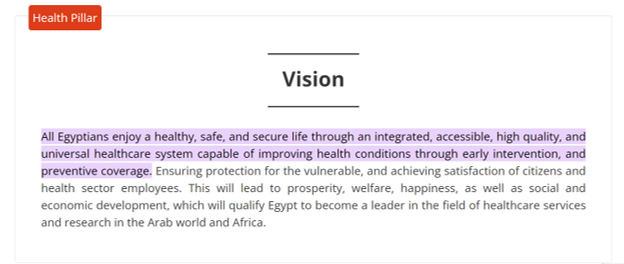 Egypt Vision 2030
An Accsight report published in 2024 found that seven of Egypt’s 16 presidential public health initiatives had provided services to 106 million citizens, generating around 3 million life-years saved and 5.8 million QALYs.
From an economic perspective, the initiatives generated estimated savings of EGP 61.3 billion compared with the cost of inaction, representing an overall 70% return on investment.
Anan said the hepatitis C campaign demonstrated four principles that could be reused across the healthcare system: nationwide screening at scale, linking diagnosis directly to treatment, using procurement and localization to make innovation affordable, and building infrastructure that can be reused across other health programs.
“Egypt can now identify risk at scale, make innovation affordable, manage patients digitally, and convert clinical outcomes into measurable economic value,” he said.
Investment opportunity shifts to integrated liver care
Three years after WHO recognition, Anan said investors, healthcare companies and policymakers should watch Egypt’s transition from a campaign-based approach to a continuous, data-driven and value-based liver-health ecosystem.
Egypt also has the potential to become a regional manufacturing and knowledge-transfer hub, he said, building on the hepatitis C experience in which local manufacturing helped improve affordability, strengthen supply security and enable treatment at scale.
The same approach could increasingly be applied to medicines, diagnostics and selected liver-care technologies.
“The HCV experience demonstrated that local manufacturing can improve affordability, strengthen supply security and enable access at scale,” Anan said.
Public-private partnerships need measurable outcomes
Anan also stressed that stronger public-private partnerships will be essential to sustaining the next phase of Egypt’s liver-health strategy.
The government, he said, should retain stewardship over national strategy, regulation, equitable access and accountability, while private-sector and academic partners can contribute technology transfer, manufacturing, financing models, clinical research, digital infrastructure and implementation expertise.
But the effectiveness of such partnerships will depend on governance.
“Every partnership should define the public-health objective, responsibilities, pricing and access conditions, data governance, measurable clinical and economic outcomes, and accountability,” Anan said.
He emphasized that the objective should not be to transfer public responsibility to the private sector, but to combine public stewardship with private and academic capabilities around measurable outcomes, including earlier diagnosis, better health outcomes, wider access and sustainable costs.
What comes after hepatitis C?
Rather than identifying a single disease as Egypt’s next major public health priority, Anan argued that the country should institutionalize a transparent economic and epidemiological framework for deciding where public health resources can generate the greatest value.
He pointed to Accsight’s ProEval Kit, which assesses potential health priorities through a Disease Spending Priority (DSP) Matrix.
The framework evaluates disease prevalence and severity, disability and suffering, healthcare and productivity costs, the availability of effective screening or treatment, and the potential return on investment.
A second layer assesses four criteria: epidemiology, clinical and economic burden, the availability of effective interventions, and long-term sustainability.
“The real story isn’t which condition comes next, it’s how we decide,” Anan said, arguing that future initiatives should be selected through a “transparent, repeatable, evidence-based process.”
For Anan, that process is ultimately the most important lesson from Egypt’s hepatitis C experience.
“Egypt has substantially defeated the virus,” he said. “The next challenge is to convert that success into a sustainable national liver-health model that protects the liver over the long term.”
The transition could make Egypt’s hepatitis C experience more than a public-health success story, positioning it as a case study in how health investment can generate measurable economic returns while strengthening the resilience of the wider healthcare system.